
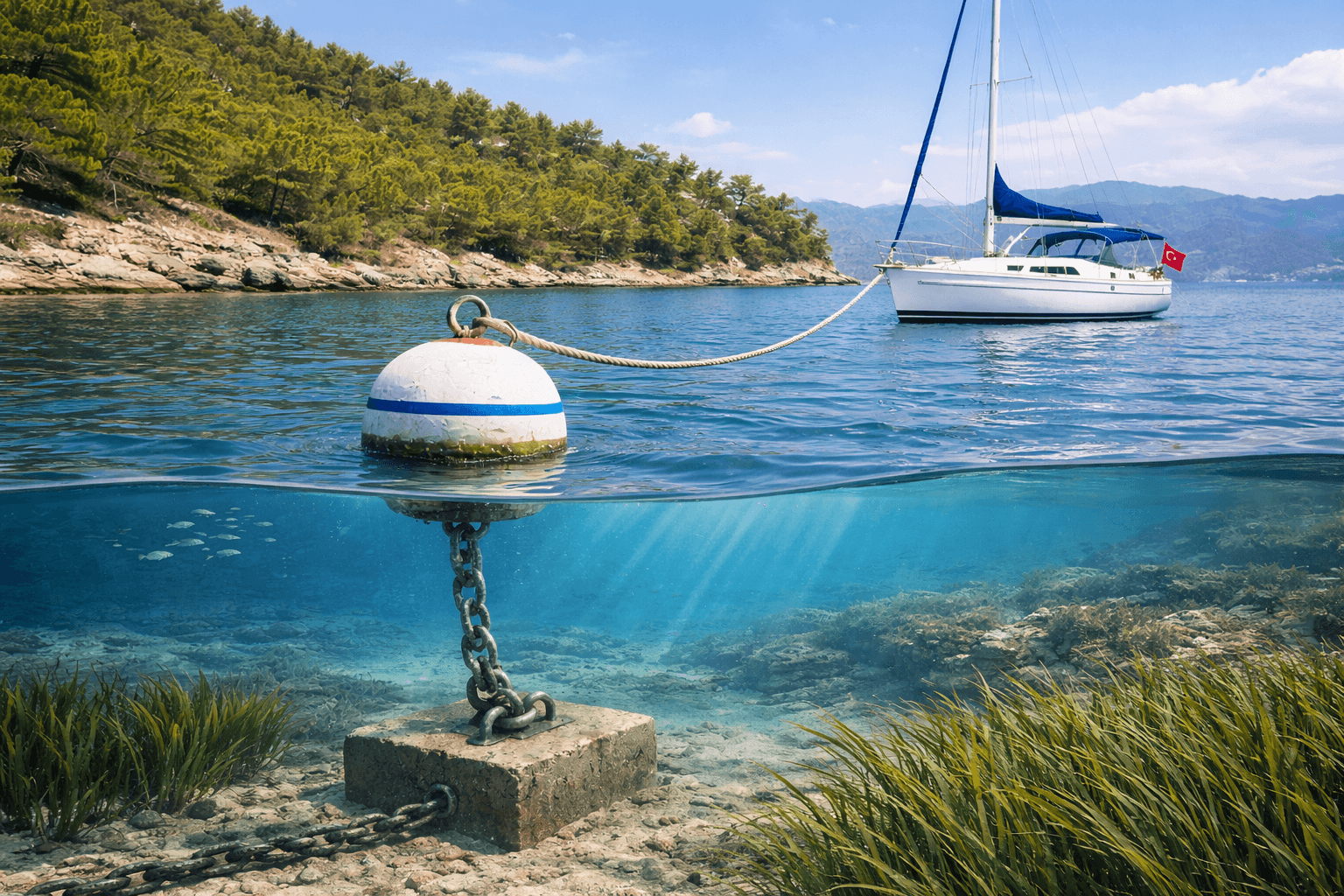
A Guide to the Environmentally Friendly Mooring System in Göcek
Many sailors visiting the bays of Göcek for the first time ask the same question:
“What are these buoys for, and why aren’t boats dropping anchor?”
The answer lies in an important environmental protection system. The mooring buoy system used in Göcek is a special anchoring method designed to protect the sensitive ecosystem on the seabed.
In this article, we will explore how the mooring buoy system in Göcek works, why it is used, and how boats connect to this system while anchoring in the bays.
What Is the Mooring Buoy System in Göcek?
The mooring buoy system is a type of anchoring infrastructure that allows boats to secure themselves without using their own anchor.
The system consists of three main components:
A seabed anchor point (mooring block or anchor system)
A buoy floating on the surface
A rope or chain used to secure the boat
The boat simply ties to the buoy and remains stable. This prevents anchor chains from dragging across the seabed.
Why Is This System Used?
Many of Göcek’s bays contain Posidonia oceanica seagrass meadows, which are extremely valuable for the Mediterranean ecosystem.
These seagrass fields provide several ecological benefits:
They create habitats for marine life
They prevent coastal erosion
They help clean and oxygenate seawater
They store carbon and support biodiversity
However, traditional anchoring methods can damage these underwater plants. When a boat drops anchor, the chain often drags across the seabed and destroys the seagrass.
The mooring buoy system was developed specifically to prevent this type of damage.
How Does the Mooring Buoy System Work?
The system operates with a simple but effective design.
1. The Seabed Anchor Point
First, a heavy anchoring system is fixed securely to the seabed. This may be a concrete block, steel anchor, or a specially designed screw anchor.
This point becomes the permanent anchor location for boats.
2. The Buoy Connection
A chain or rope extends from the seabed anchor point up to the surface, where it is attached to a floating buoy.
The buoy remains visible on the water surface so that approaching boats can easily identify and use it.
3. Boat Mooring
When a boat arrives in the bay:
It does not drop its own anchor
It ties a line to the buoy
The boat remains safely secured in position
This prevents the anchor chain from dragging along the seabed and protects the underwater ecosystem.
Where Is This System Used in Göcek?
The mooring buoy system is mainly used in protected bays around Göcek.
Some examples include:
Bedri Rahmi Bay
Sarsala Bay
Göbün Bay
The waters around Tersane Island
In these areas, anchoring may be restricted or discouraged to protect marine habitats.
Important Things to Consider When Using a Mooring Buoy
When using a buoy system, there are several basic guidelines sailors should follow.
Proper Distance
Boats should be tied in a way that prevents direct contact with the buoy.
Rope Length
The mooring line should be adjusted according to wind conditions and wave movement.
Weight Capacity
Each buoy is designed for a specific boat size and weight. Using a buoy beyond its capacity may be unsafe.
Who Manages This System?
The mooring buoy systems in Göcek are generally installed and managed by organizations such as:
The Turkish Ministry of Environment
Local marina authorities
Environmental protection initiatives
In some bays, the use of these buoys may require a small fee.
Advantages of the Mooring Buoy System
This system provides several important benefits:
Protects seagrass meadows
Reduces anchor congestion in popular bays
Creates more organized anchoring areas
Prevents anchor chains from damaging the seabed
It also makes anchoring easier for less experienced sailors.
Conclusion
The mooring buoy system in Göcek is a successful example of how boating and environmental protection can work together.
Thanks to this system, boats can safely moor while the fragile marine ecosystem remains protected.
One of the reasons Göcek’s bays are still so clean and natural today is this careful approach to conservation.
Because the sea is not just a place for travel and tourism - it is a living environment that must be preserved.